

Why SaaS Founders Should Care About HDD
Building a startup means constantly navigating trade-offs: limited capital, aggressive timelines, and overwhelming uncertainty. Most founders operate on gut instinct. They often don’t know whether customers even want what they’re building, let alone if they’ll pay for it. This is where many startups go sideways. They move fast, build hard, and burn out because they made decisions based on assumptions, not evidence.
Hypothesis-driven development (HDD) offers a smarter path forward. It’s a methodology and mindset that shifts product development from guesswork to validation. Instead of asking, “Can we build this?” HDD asks, “Should we build this, and how do we know?”
By treating every idea as an experiment, HDD allows startups to move fast without building blindly. It prioritizes learning over assumptions and turns your product roadmap into a strategic asset, not a list of hopeful bets. HDD isn’t just another trendy acronym; it’s your blueprint for clarity, focus, and traction in a world that rewards those who learn faster than everyone else.
Why Feature Assumptions Kill Startups
Building based on untested assumptions is one of the costliest mistakes in early product development. Startups often launch features because they “feel right,” only to discover users don’t need or want them.
Evidence-based decision-making also makes communication with investors and stakeholders easier. You’re no longer saying “we believe this will work” but rather, “we tested this, and here’s what we found.” That builds trust and positions you as a thoughtful, data-savvy founder. This mindset gives you a competitive edge in today’s fast-moving tech landscape. You don’t have to guess your way to success; you can learn your way there, one hypothesis at a time. And that discipline doesn’t slow you down; it speeds you up in the right direction.
There is no need to spend precious engineering hours and burn through runway on features that may never gain traction. Worse, you’re delaying the learning that could’ve steered you in a better direction. HDD addresses this by forcing clarity early in the process. You treat assumptions as hypotheses, not truths. Instead of building a new feature because it sounds good, you define a testable prediction:
“If we simplify our signup form, we expect user completion rates to increase from 40% to 60% in 7 days.”
This data-driven approach creates team alignment and builds trust with stakeholders and investors. You’re not just saying, “We believe this will work,” you’re saying, “We tested this, and here’s the outcome.” You don’t just work harder; you work smarter. You don’t build everything; you build what matters. And that’s how you create traction, confidence, and a product that stands a chance in the real world.
What Is Hypothesis-Driven Development?
Hypothesis-Driven Development is a product strategy that treats ideas as experiments. Before investing time or resources into development, teams define clear, testable hypotheses and design lightweight experiments to validate them.

It’s the application of the scientific method to product development. You start with a hypothesis, define expected outcomes and success metrics, run a small test, and measure the results. Based on your learning, you either move forward, adjust, or discard the idea. HDD helps you eliminate guesswork, reduce waste, and prioritize only what delivers real value.
HDD doesn’t slow you down; it helps you move faster in the right direction. For SaaS startups under pressure to find a product-market fit, that speed + precision combo is a major advantage.
Hypothesis-drive development for SAAS founders
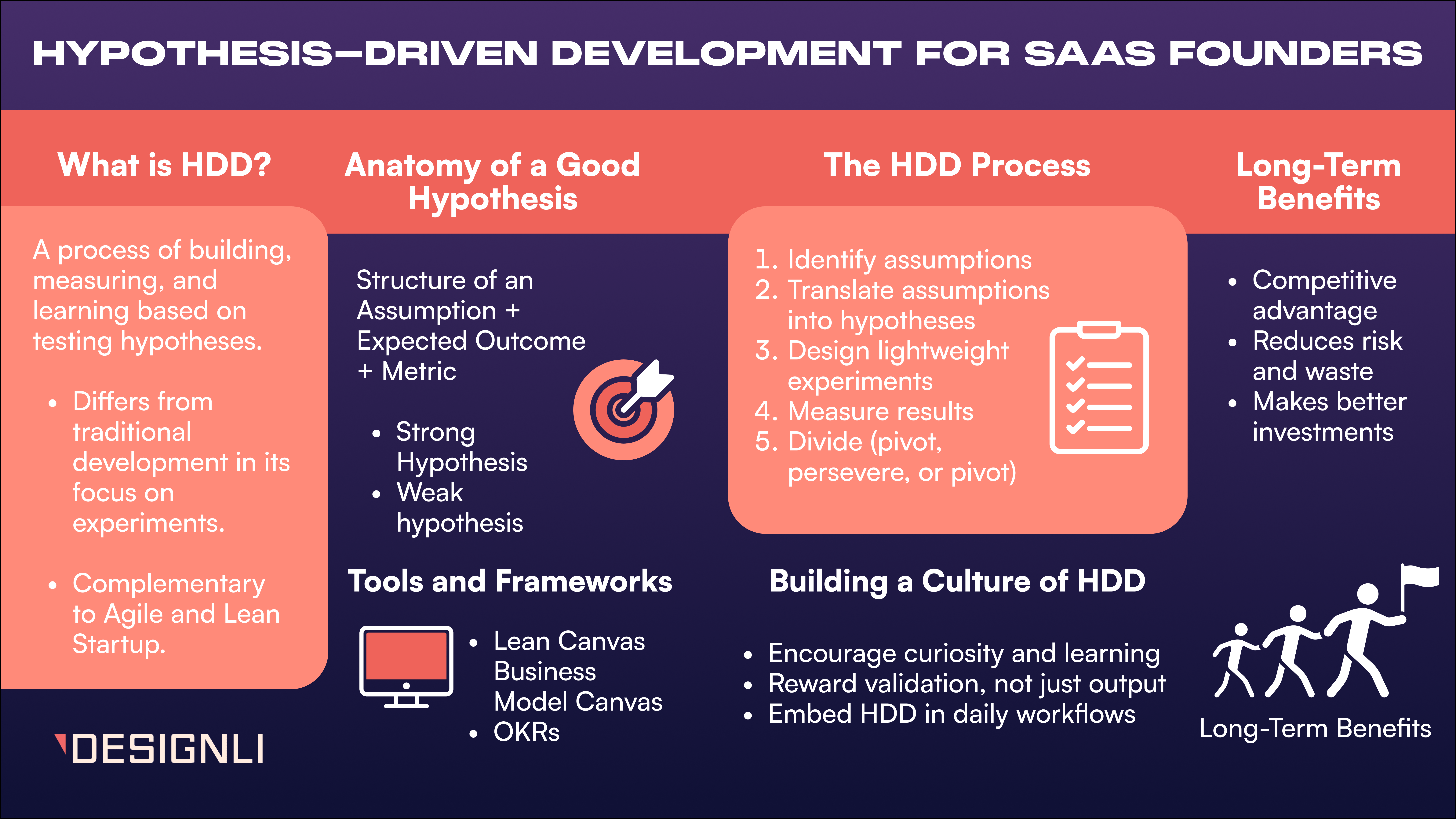
Source: Designli
HDD vs. Agile vs. Lean Startup: How They Work Together
Founders often wonder: “Is HDD just Agile or Lean Startup with a different name?”
The answer: They’re complementary frameworks. Here’s how they fit:
- Agile helps teams execute faster by breaking work into sprints and adapting to change.
- Lean Startup promotes iteration and validated learning to avoid waste.
- HDD provides the missing layer: deciding what to build in the first place by testing assumptions early.
Example:
- HDD: Hypothesis “A 7-day trial will improve paid conversions by 20%”
- Agile: Sprints to build and test the new trial flow
- Lean: Evaluate whether this aligns with the broader business model
When used together, these approaches create a closed-loop learning system. You validate ideas (HDD), build quickly (Agile), and align with business goals (Lean). These three frameworks drastically improve your learning cycle and allow you to move with confidence instead of chaos. So, rather than picking one over the other, innovative founders integrate all three, using HDD to discover what matters, Agile to build it quickly, and Lean to make sure it fits the bigger picture. That’s how modern startups win.
How to Write a Good Hypothesis
A strong hypothesis is the beating heart of Hypothesis-Driven Development (HDD). It’s not just a random idea scribbled on a whiteboard; it’s a structured, testable statement that helps your team learn something specific about your users, product, or business. The anatomy of a strong hypothesis comes down to three essential parts:
Assumption + expected outcome + measurable metric
Weak vs. Strong Hypotheses
- Weak: “We think users will like the new onboarding design.”
→ Vague, subjective, and unmeasurable - Strong: “We believe that showing a visual progress bar during onboarding will increase completion rates from 45% to 65% within one week.”
→ Specific, actionable, and data-driven
This version is powerful because it has structure. You’ve identified what you’re changing (adding a visual progress bar), what you expect to happen (an increase in completion rates), and the metric to track (completion rate percentage). Plus, you’ve given it one week, which helps keep your experiment lean and focused. Strong hypotheses help your team stay aligned and action-oriented. Weak ones open the door to confusion, scope creep, and wasted development time. Measurable outcomes allow your team to objectively say, “Yes, this worked,” or “No, this didn’t move the needle.” And that clarity is invaluable for early-stage startups, where time and budget are limited.
As a founder, pushing your team to write better hypotheses consistently is one of the simplest ways to improve your product strategy and make smarter bets faster.
If you want a deeper breakdown of how validation supports smarter technical choices, this guide outlines the key steps and scenarios.
The HDD Process: 5 Steps to Smarter Product Development
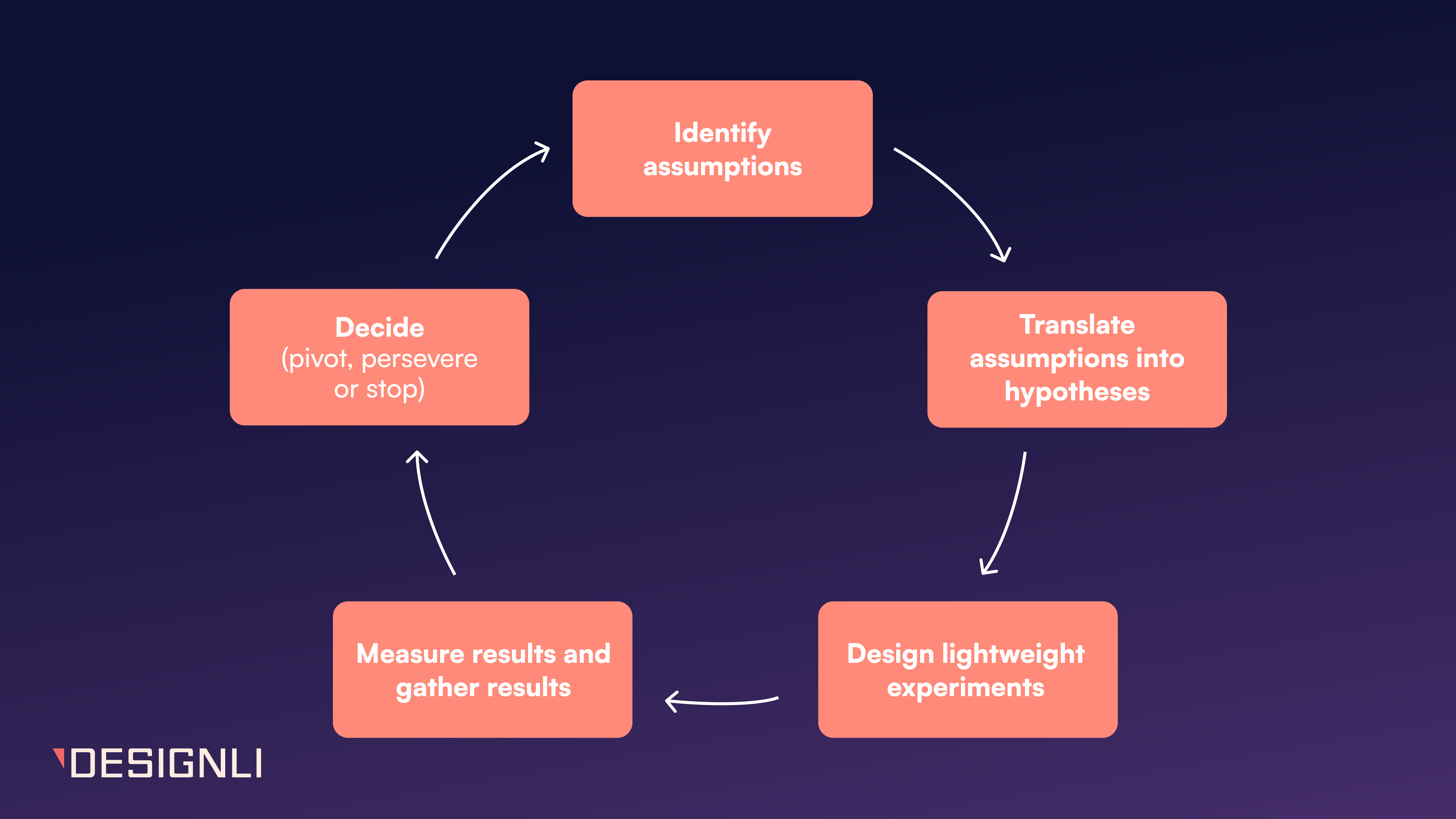
Instead of blindly executing roadmaps, HDD helps teams break product decisions into 5 focused steps, turning assumptions into learning loops. Below is the step-by-step process that turns hopeful ideas into tested, strategic decisions.
Step 1: Identify Assumptions
Every product idea is built on a foundation of assumptions, many of them invisible, unspoken, and untested. These assumptions drive your roadmap, UI decisions, pricing, and positioning. If they’re wrong, everything downstream suffers.
Start by asking: What needs to be true for this idea to succeed?
Write down every assumption you’re making about users, value, pricing, and behavior. Then prioritize based on risk:
- Which assumptions, if wrong, would have the biggest impact?
- Which ones are easiest to test right now?
This clarity prevents you from building on shaky foundations. It gets you out of “we think” mode and into a position where you build on what you know or will soon know.
Step 2: Turn Assumptions Into Hypotheses
Once you’ve identified your assumptions, it’s time to turn them into clear, testable hypotheses. This is where things take shape, where speculative thinking becomes structured learning.
Translate high-risk assumptions into testable predictions. Structure each hypothesis around one key variable and define:
- What you’re changing
- What you expect to happen
- How you’ll measure the result
- Over what timeframe
Example:
Assumption: “Users don’t complete onboarding because it takes too long.”
Strong hypothesis: “If we reduce the onboarding steps from five to three, we will increase completion rates from 45% to 65% over one week.”
This statement is clear, specific, and measurable, ready for testing. As a founder, this step is where you start turning vague ideas into an actionable product strategy.
Step 3: Design Lightweight Experiments
Now that you’ve got a solid hypothesis, it’s time to design the smallest possible experiment to test it, quickly and without burning unnecessary resources. This is where HDD shines. Instead of building out full-blown features or launching months-long initiatives, you’re asking: What’s the leanest way we can validate this?
Low-effort experiment types include:
- Landing page A/B tests
- Click-through prototypes (e.g., Figma)
- No-code tools (e.g., Webflow, Bubble)
- Email campaigns
- User interviews
The goal is maximum learning with minimum building. You don’t need to scale what hasn’t been validated.
Step 4: Measure Results and Gather Feedback
It’s time to measure the results and gather insights. This is where your hypothesis holds water or falls apart. Either outcome is a win.
Also collect qualitative feedback:
- What confused users?
- Where did they drop off?
- What patterns emerged?
When you learn how to read your data, interpret it well, and act on it fast, you create a competitive advantage most startups never develop.
For how to spot churn early using feedback loops, see this guide.
Step 5: Decide – Pivot, Persevere, or Stop
After measuring results and reviewing feedback, it’s time to pivot, persevere, or stop. This is where HDD becomes not just a development method, but a decision-making framework.
Based on what you learn, choose one of three paths:
- Persevere: Your hypothesis was validated. Build it out.
- Pivot: You saw partial success but need to adjust the idea.
- Stop: The test failed, so it’s time to redirect.
Even a “failed” test is a win; it saves you from building the wrong thing. HDD empowers founders to make these decisions quickly and confidently.
HDD design-making framework
Source: Designli
Tools That Make HDD Work at Scale
The right tools help your team stay focused, aligned, and organized throughout the HDD process. Here are some that support each step:
1. Lean Canvas & Business Model Canvas
These are two of the most powerful foundational tools for startup founders. Why? Both canvases are designed to help you visualize assumptions in your business and identify high-risk areas worth testing. They are ideal for early-stage SaaS teams planning initial experiments.
2. OKRs (Objectives & Key Results)
Tie your hypotheses to strategic goals.
Example:
- Objective: Improve activation
- Key Result: “Increase onboarding completion from 50% to 70%”
This keeps experiments aligned with business impact.
3. Airtable
A supercharged spreadsheet that can be customized into a lightweight database. You can create columns for hypothesis statements, status, metrics, experiment owners, timelines, and outcomes. Add views by week, team, or experiment type, and your team instantly has a living experiment dashboard.
4. Notion
Create an “HDD Hub” to document hypotheses, embed results, link user interviews, and centralize all insights. Especially useful for cross-functional teams.
5. Jira Add-ons
For engineering teams already using Jira, extensions allow you to treat experiments as tickets, connecting them to sprints and user stories.
This keeps testing efforts visible in your dev workflow.
6. Google Analytics
Good for macro-level insights like bounce rate, flow analysis, and campaign performance. Essential for testing landing pages or top-of-funnel ideas.
7. Mixpanel
Track specific in-product events and funnels. Ideal for understanding user behavior and validating feature engagement.
8. Amplitude
Powerful cohort analysis and retention tracking. Great for long-term experiments measuring activation or churn over time.
Build Less, Learn More, Win Faster
HDD gives SaaS founders a smarter way to work. Instead of rushing to build and hoping for adoption, you move with clarity, focus, and evidence.
It helps you:
- Reduce waste
- Align teams around data
- Build things users actually want
- Communicate results to stakeholders with confidence
Learning faster than the next startup gives you an edge in a world where capital is limited and competition moves quickly. Hypothesis-driven development is a fundamental step to optimizing product strategy. Learn more about our view on it and how it can help you develop a product. Schedule your consultation and let’s get started.