
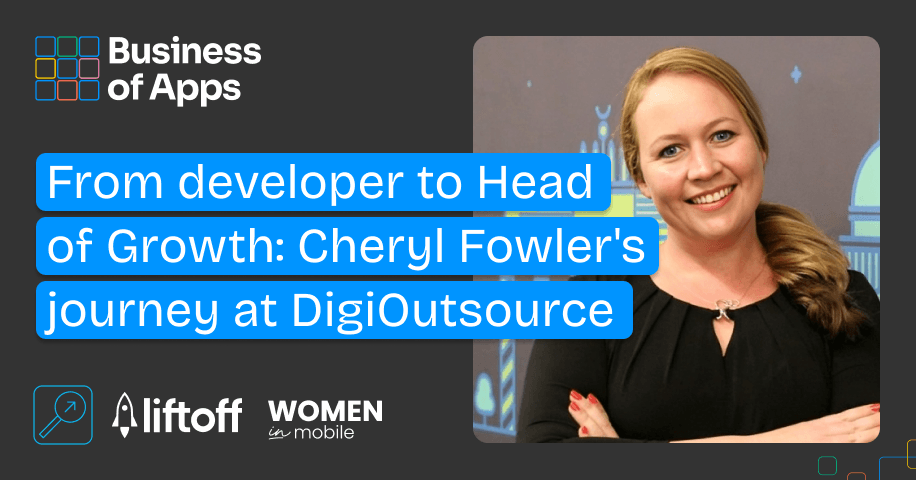
Mobile app advertising, monetization, and insights company Liftoff is bringing together inspirational women from across the mobile industry to share their stories. In this series, we’ll explore their achievements, the challenges they’ve overcome, and their vision for the future — offering insights from the experts shaping the world of mobile apps and technology.
This month’s article focuses on Cheryl Fowler, Head of Growth Marketing at DigiOutsource.
Can you start by walking us through your career path — how did you get to where you are today?
I began my career at DigiOutsource as a junior web developer, where my main responsibility was turning PSDs into mailers. Driven by a desire for more complex challenges, I expanded into web development for our systems, moved into backend coding, and eventually led the team that built our first mobile casino when mobile started gaining momentum.
From there, I stepped into a technical lead role, which ultimately presented me with a choice: continue down a purely technical path or pivot toward strategy. I chose strategy, but I still kept close to coding. That decision led me to the role of Head of Development, overseeing the teams responsible for all customer-facing applications and services.
Throughout my journey, I’ve always been passionate about the customer. About a year ago, I transitioned into my current role as Head of Growth Marketing, where I bring together my technical background, customer-first mindset, and marketing expertise to drive growth for the business.
What’s the single biggest challenge you face in this role, and how are you building your team and processes to overcome it?
I’d say translating great ideas into strategies that actually go live. In a large organisation with multiple priorities, influencing and aligning on a single direction is often the most difficult part. As I often say, everyone has ideas, but the real challenge is in turning ideas into something tangible that delivers a great customer experience and impacts the bottom line.
To overcome this, I focus on building credibility and trust across the business. That means listening closely, bringing data and customer insights to the table, and showing consistency in delivery. I’ve also been intentional about building a team and adaptable, collaborative, and transparent processes so that when we push a strategy forward, stakeholders feel confident, informed, and invested. Over time, this approach has helped us navigate complexity and ensure that the ideas we champion translate into measurable growth.
What advice would you have for other women in tech looking to take their next step on the career ladder?
Believe in yourself and the impact you can make. Confidence, decisiveness, and credibility are key. When you carry those, people naturally want to know who you are and trust in the value you bring.
It’s not always easy, but clarity on where you want to grow and the determination to push for it will carry you forward. At the same time, stay humble. Listen, learn, and let your results speak for you. Empowerment isn’t something that’s given—it’s something you build by showing up, being consistent, and proving to yourself (and others) that you belong at the table.
If you could go back in time and give yourself one piece of advice at the start of your career, what would it be?
I would tell myself to be patient. The saying “Rome wasn’t built in a day” is absolutely true. Your time will come, and all the effort, learning, and persistence you put in along the way will be worth it.
User acquisition can be expensive. How do you balance the need for high-volume acquisition with the imperative to acquire high-lifetime-value (LTV) users?
It really comes down to balance and vigilance. We constantly weigh ROI, CPA, spend, and LTV against each other, and we know exactly what levers to pull when one of those metrics shifts. High-volume acquisition is important for scale, but we’re equally disciplined about targeting quality users who will deliver long-term value.

That means having the right data infrastructure in place, watching signals early, and being agile enough to adjust spend, creative, or targeting when performance indicators change. Ultimately, it’s about not chasing volume at the expense of sustainability. Every decision has to balance short-term growth with long-term profitability.
The online gambling and gaming industries are heavily regulated, with rules changing frequently. Has it been difficult building a growth strategy that is both effective and compliant?
We’ve always believed regulation is essential. It protects customers and ensures black-market operators don’t have a foothold in the industry. For us, duty of care is our first priority. We want customers to enjoy our platforms for what they’re meant to be: fun and entertaining experiences within healthy boundaries.
Because we’ve held that belief, evolving regulations haven’t been a barrier. They’ve simply reinforced the way we think casinos and sportsbooks should operate. Building a growth strategy that is both effective and compliant isn’t about compromise—it’s about aligning with principles that put customers first while still driving sustainable growth.