

As ad platforms become increasingly automated, many of the levers performance marketers once relied on are disappearing. Targeting options are narrowing, optimization controls are abstracted away, and algorithms are doing more of the decision-making behind the scenes. In that environment, one question is becoming critical: what signals are we actually feeding those algorithms?
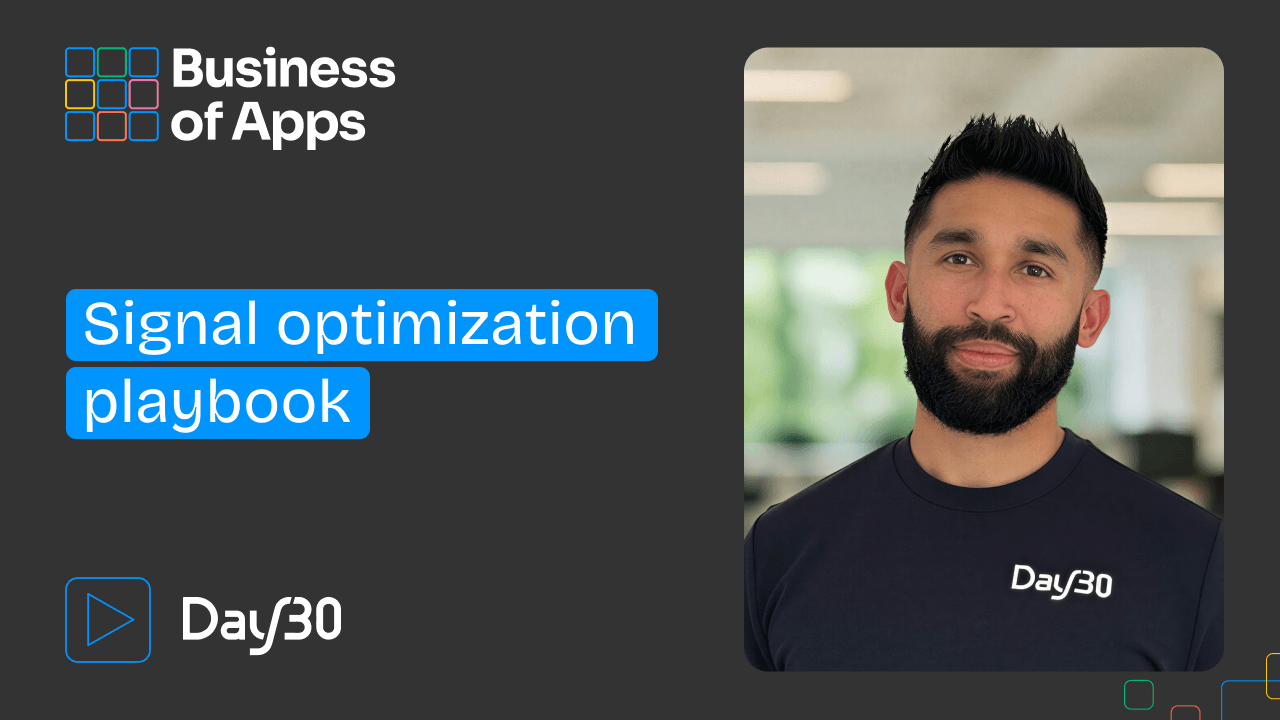
At Business of Apps Berlin 2025, Shumel Lais, Co-Founder at Day30, unpacked why signal optimization is emerging as one of the last meaningful growth levers for app marketers and how getting it right can materially lower CAC and improve ROAS.
When optimization moves into a black box
Shumel opened by acknowledging the pressure most growth teams are under. Competition is rising, CPMs are climbing, and AI-generated apps are flooding the stores. At the same time, platforms like Meta and Google are becoming more algorithmic and opaque.
Where marketers once tweaked bids, audiences, and structures, today there are far fewer controls. Creative remains important but even that may soon be partially automated. That leaves one major lever still firmly in the hands of marketers: the signal.
What signals really mean to ad platforms
At its core, a signal is the goal event you ask an ad platform to optimize towards — installs, trials, purchases, subscriptions, or renewals. These events teach algorithms what “good” looks like so they can find similar users at scale.
Shumel compared this to a sports scout. Give the scout a clear definition of success — say, players who score ten goals in a season — and they can identify the traits that matter. Feed vague or incomplete goals, and results suffer.
The problem is that on mobile — especially on iOS — signals often stop at day one or day seven. What marketers actually care about, such as renewals, lifetime value, or ROAS, typically happens much later.
The signal visibility gap
Because platforms can’t reliably see beyond the attribution window, many subscription apps end up optimizing to cost per trial rather than cost per subscriber. This creates a disconnect between what platforms optimize for and what businesses actually value.
Signal optimization, Shumel argued, is about closing that gap. The goal is to predict meaningful downstream outcomes — like a day-8 renewal or day-30 ROAS — using behaviors that occur within the first 24 hours.
Signal optimization playbook
Source: Business of Apps via YouTube
A framework for signal optimization
To make this practical, Shumel shared a three-part framework for evaluating signals before spending a dollar of media budget.
The first dimension is precision, or the conversion rate of users who trigger a signal. Higher precision means stronger correlation with the outcome you care about.
The second is signal volume. Algorithms need enough data to learn patterns. A highly predictive signal is useless if it fires too infrequently to sustain optimization.
The third — and often overlooked — factor is recall. A signal with very high precision can still be harmful if it excludes a large share of users who would have converted anyway. In that case, you’re effectively telling the algorithm that good users are bad.
The challenge is finding the right balance between all three.
Why correlation isn’t enough
Shumel illustrated the risks with a real-world example from earlier in his career: a restaurant booking app that optimized campaigns based on early behaviors that appeared correlated with bookings. Despite promising-looking data, performance didn’t improve.
What this shows is that correlation alone isn’t sufficient. Signals must be evaluated within clearly defined cohorts, time windows, and prediction statements — something data science is particularly good at enforcing.
From theory to results
The session moved from theory to practice with examples from real apps.
In one case, a photo storage app attempted to optimize toward users who started a trial and uploaded thousands of photos. While precision improved slightly, recall dropped sharply, excluding over a third of users who would have converted.
By applying machine learning to identify more nuanced early behaviors, Day30 helped the app increase precision by around 40% while maintaining roughly 80% recall, a far more effective signal.
In another experiment across multiple campaigns on Meta, three optimization strategies were compared: installs, trials, and a predictive signal. Each did exactly what the platform was told — cheapest installs, cheapest trials, and, ultimately, the strongest CAC and ROAS performance when optimizing toward the predictive signal.
The takeaway for growth teams
Signal optimization doesn’t replace creativity or instinct. It puts them under scrutiny before budget turns into exposure.
Shumel’s top pieces of advice:
- Start with a clear prediction statement
- Use early behaviors to predict what really matters
- Balance precision, volume, and recall
- Test incrementally before going live
- Iterate continuously as user behavior evolves
As automation increases, the quality of inputs matters more than ever. In a world where platforms optimize perfectly for whatever you ask of them, the real competitive advantage lies in asking the right question.
Watch the recording to discover all of Shumel’s insights. You can also watch all the sessions from Business of Apps Berlin 2025 here.