

For years, app monetisation discussions have focused on fill rates, eCPMs, and demand sources. But one critical variable has often been treated as a necessary evil: ad quality. As user expectations rise and competition intensifies, that trade-off is becoming increasingly dangerous.
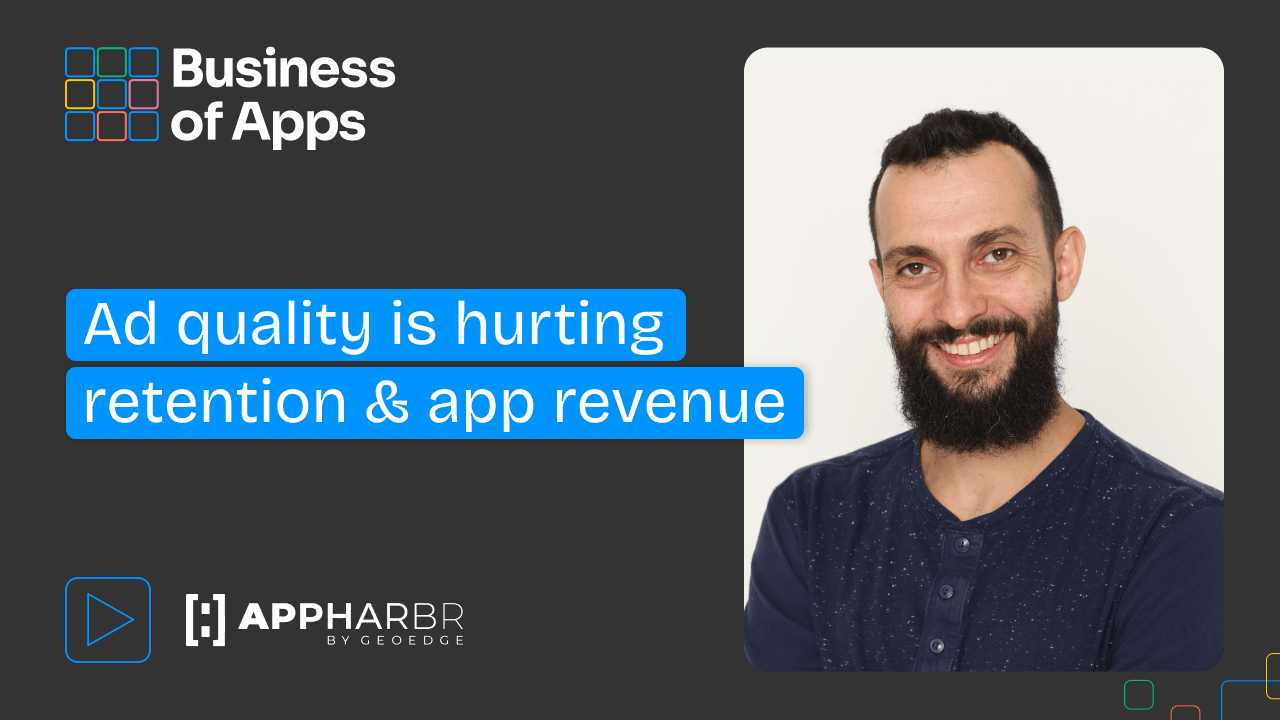
In the latest edition of App Talks, David Murphy spoke with Alex Yerukhimovich, GM at AppHarbr, about why ad quality is no longer a secondary concern and how bad ads quietly erode retention, revenue, and trust across the app ecosystem.
Why ad quality is becoming a growth problem
Alex describes ad quality as a user experience issue first, not a monetisation one. Users don’t distinguish between app content and ad content. To them, everything that appears on screen belongs to the app.
That perception creates a fundamental risk for publishers. When ads feel deceptive, disruptive, or malicious, users don’t blame ad networks, they blame the app itself.
As Alex explains, this problem has traditionally been most visible in gaming, where high-paying formats like rewarded video have historically justified aggressive ad behaviour. But the challenge is now spreading rapidly into non-gaming apps, where user lifecycles are longer and retention is far more valuable.
The three types of bad ads
AppHarbr categorises ad quality issues into three core buckets:
The first is unwanted content — ads or landing pages that are violent, inappropriate, or simply off-brand for the app.
The second is bad ad behaviour. These ads may look fine on the surface but disrupt the user experience by playing loud audio, triggering vibrations, or hijacking the screen with unskippable full-screen formats.
The third, and most dangerous, category is malvertising. These ads are intentionally deceptive, designed to manipulate users into handing over personal or financial information. Common examples include fake virus alerts, false system warnings, scam investment promotions, and AI-generated deepfake endorsements.
According to AppHarbr’s recent data, one in every 77 ads served in gaming apps is malicious. In non-gaming apps, it’s roughly one in 120 — a gap that is narrowing fast.
Ad quality is hurting retention and app revenue
Source: Business of Apps via YouTube
The hidden cost of “letting it slide”
One of the biggest misconceptions Alex highlighted is the belief that bad ads are tolerable because they pay well. In reality, publishers rarely know whether that’s true.
Without full visibility into their ad inventory, publishers can’t see what happens when a bad ad is blocked. In most cases, Alex says, the second-highest bidder fills the slot at nearly the same price, without damaging the user experience.
The real costs of bad ads show up elsewhere:
- Shortened sessions when users close apps early
- Higher churn and uninstall rates
- One-star reviews that hurt ASO and future installs
- Long-term damage to brand trust and lifetime value
For apps with long-term usage — weather, finance, live scores, utilities — losing even a single loyal user due to ads can outweigh short-term monetisation gains.
From blind spots to full transparency
AppHarbr’s core mission is to give publishers full visibility and control over the ads shown in their apps.
Alex points out that while some ad networks and mediations provide limited reporting tools, most developers still can’t confidently answer basic questions like which ad verticals dominate their inventory or where quality issues originate.
The first step is transparency, or knowing exactly what ads are being served, by which networks, and how users are exposed to them. The second step is enforcement, or the ability to block or reject problematic ads in real time, without relying on slow or incomplete third-party responses.
A smarter ad ops workflow
Beyond protection, ad quality tools unlock new operational and optimisation opportunities.
With granular control, publishers can:
- A/B test blocking specific ads or advertisers
- Segment enforcement by OS, country, or user type
- Balance UX improvements against real revenue impact
- Customise ad experiences for different user cohorts
This allows teams to move away from one-size-fits-all monetisation strategies and toward a more nuanced balance between revenue performance and user satisfaction.
Why good ads actually help monetisation
Alex is clear that ads themselves are not the enemy. Good ads — relevant, clearly dismissible, well-timed, and non-deceptive — enable free content and sustainable business models.
Users are willing to engage with advertising when it respects their time and attention. The goal isn’t to remove ads, but to make them safe, transparent, and predictable.
The bigger picture
As ad quality continues to deteriorate across the ecosystem, Alex argues that passive acceptance is no longer an option. Solving the problem requires both better tooling and a more vocal industry response.
Publishers, platforms, and ad tech providers all share responsibility. If bad actors are consistently blocked and exposed, the incentive structure shifts, improving outcomes even for smaller developers who lack leverage on their own.
The takeaway
Ad quality isn’t a monetisation edge case anymore. It’s a core growth variable.
From retention and reviews to revenue stability and brand trust, the ads inside an app are inseparable from the app itself. As Alex succinctly put it, if the ads in your app are bad, your app is bad.
Watch the full video to discover all of Alex’s insights. You can also watch all episodes of App Talks here.