
Subscription apps are no longer the scrappy sibling of mobile gaming. They now represent one of the fastest-growing segments in the app economy — but they’re also facing a far more complex growth environment than even a few years ago. Between iOS privacy changes, fragmented measurement, rising acquisition costs, and increasingly algorithmic ad platforms, sustainable growth now depends less on hacks and more on fundamentals.
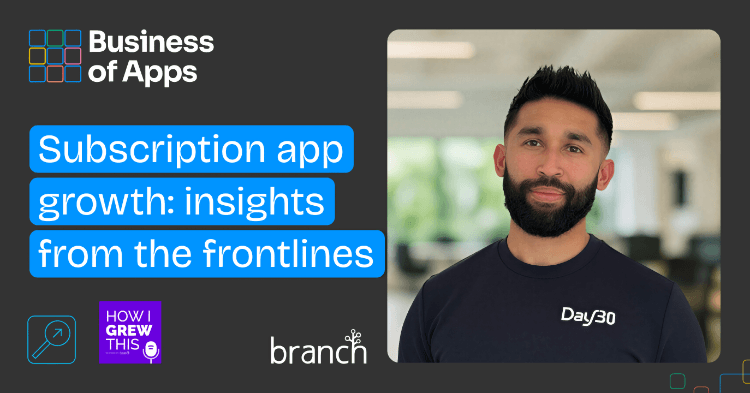
That was the core theme of a recent episode of Branch’s How I Grew This podcast, featuring Shumel Lais, founder of Day30 and longtime advisor in mobile growth and analytics. Drawing on more than a decade of experience across agencies, analytics platforms, and subscription businesses, Lais offered a grounded look at what actually works for subscription apps today — and where many still go wrong.
Why subscription apps lag behind gaming
One of Lais’s central observations is that the app ecosystem has long been split into two dominant verticals: gaming and non-gaming subscription apps. While gaming companies are typically well equipped with business intelligence, data science teams, and sophisticated tooling, subscription apps often operate with far less analytical depth.
That imbalance matters more than ever. As user acquisition becomes more algorithm-driven and privacy-constrained, growth teams are increasingly reliant on the quality of the signals they feed into ad platforms. Without strong data foundations, subscription apps struggle to compete — not because demand isn’t there, but because decision-making lacks precision.
This gap is precisely what motivated Lais’s work over the years, from building analytics platforms to advising subscription businesses directly. The opportunity, he argues, isn’t about chasing growth shortcuts, but about bringing the same analytical rigor to subscriptions that gaming has had for years.
From spreadsheets to real-time decisions
Earlier in his career, Lais experienced firsthand how fragmented mobile data used to be. Performance data lived in spreadsheets, revenue data sat elsewhere, and stitching the two together was a manual, time-consuming process. The result? Teams reviewed performance weekly — sometimes even less — making it nearly impossible to react quickly.
Today, while tooling has improved, the underlying lesson remains the same: growth suffers when data is delayed or incomplete. Marketers don’t need to become SQL experts, but they do need access to timely, trustworthy data that reflects the full customer journey.
For subscription apps, that means understanding not just installs or trials, but how different users behave across plans, time horizons, and engagement levels. Weekly subscribers behave very differently from annual ones — and without event-level visibility, those differences are invisible.
The real challenge of iOS measurement
Despite years passing since Apple’s major privacy changes, Lais notes that many large apps are still struggling to adapt. SKAdNetwork remains widely used, but it provides limited, delayed feedback — especially problematic for subscription models where value accrues over time.
What’s emerging instead is a shift toward probabilistic and privacy-preserving measurement approaches offered by major platforms. These methods don’t restore perfect visibility, but they do provide something just as important: confidence.
Confidence in longer-term decision-making is what allows teams to invest, test, and scale without overreacting to short-term noise. In a world where ad platforms optimize on seven-day windows but businesses care about twelve-month lifetime value, bridging that gap becomes critical.
Early-stage mistakes that slow growth
For early-stage subscription apps, Lais sees a familiar pattern repeat itself. Founders want results immediately — often because cash is tight — and expect user acquisition to pay back almost instantly. While understandable, this mindset can quietly cap growth.
Small budgets tend to capture the lowest-hanging fruit: users most likely to convert quickly. As spend increases, acquisition inevitably widens to less certain audiences, extending payback periods. Teams that insist on immediate ROI often stall right at this inflection point.
Instead, Lais encourages founders to model growth realistically. Larger apps scale faster precisely because they accept longer payback windows — sometimes six to twelve months — knowing that strong retention ultimately justifies the investment.
Data before perfection
Another common trap is waiting for the “perfect” funnel before investing in growth. In reality, funnels are refined through data, not designed in isolation. Without sufficient traffic, benchmarks never form, and optimization remains theoretical.
Paid acquisition, while expensive, provides fast feedback. It reveals which messages resonate, which features matter, and where users drop off. That insight doesn’t just improve ads — it improves onboarding, positioning, and even product direction.
The key is intentionality. Paid traffic isn’t about scaling prematurely, but about learning efficiently.
AI, creative volume, and paywalls
On the creative side, Lais sees AI accelerating experimentation rather than replacing strategy. Platforms like Meta increasingly reward volume and variety, making it easier for AI-generated creative to fill the pipeline. Whether AI consistently produces true “winners” remains an open question — but its ability to speed up testing is undeniable.
Paywalls, meanwhile, remain one of the most critical — and time-sensitive — elements of subscription success. Data consistently shows that most users who subscribe do so within minutes of opening the app. That makes paywall design, placement, and testing non-negotiable.
While paywall tools are becoming more standardized, Lais believes optimization here is now table stakes. The question isn’t whether to test paywalls, but how systematically teams do it.
Scaling requires patience, not shortcuts
Ultimately, the episode reinforces a simple but often overlooked truth: sustainable subscription growth is built on patience, data discipline, and realistic expectations. The “crappier” the product, the faster payback must be. The better the product, the longer teams can afford to wait.
As subscription apps continue to grow — fueled in part by lower barriers to entry and AI-driven development — competition will only intensify. Those that win won’t be the ones chasing quick returns, but the ones building strong signals, understanding their unit economics, and making confident decisions in an imperfect data world.
In that sense, the future of subscription growth looks less like clever hacks — and more like grown-up marketing.
Tune in to listen to the episode below.